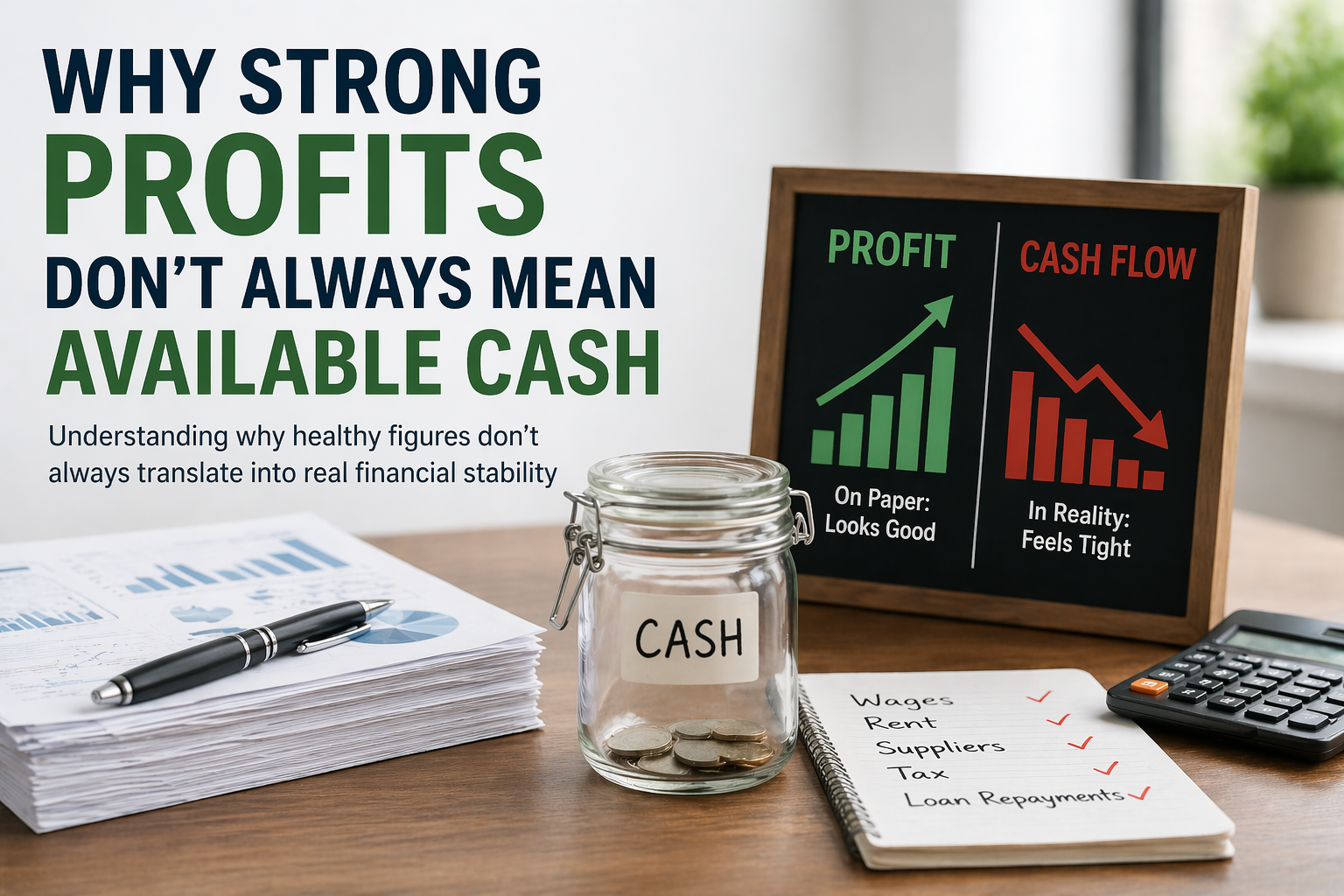
Understanding why healthy figures don’t always translate into real financial stability
For many business owners, seeing strong profits is a reassuring sign that everything is working as it should. Sales are coming in, margins look healthy, and the numbers on your accounts suggest success. However, this can sometimes create a false sense of security. Despite reporting solid profits, many businesses still find themselves struggling to pay bills, cover wages, or invest in growth. The reason for this disconnect lies in the difference between profit and cash flow.
Profit is an important indicator of performance, but it doesn’t always reflect the true financial position of your business. Without sufficient available cash, even the most profitable companies can face serious challenges.
The key difference between profit and available cash
Profit is calculated by subtracting your expenses from your revenue over a specific period. It gives a snapshot of how well your business is performing financially. However, profit is often recorded when a sale is made—not when the money is actually received.
Available cash, on the other hand, refers to the money physically sitting in your bank account. It determines whether you can meet your immediate financial obligations, such as paying suppliers, staff, or rent.
This distinction is crucial. You can have a profitable business on paper while still experiencing cash shortages if your income hasn’t yet been received.
How timing differences create financial pressure
One of the biggest reasons strong profits don’t translate into available cash is timing. Many businesses operate on credit terms, meaning customers are given time to pay invoices. While this income is recorded as profit, the cash may not arrive for weeks or even months.
Meanwhile, your expenses don’t wait. Wages, utilities, rent, and supplier invoices often need to be paid promptly. This creates a gap between money going out and money coming in, which can quickly lead to cash flow pressure.
If this gap isn’t managed properly, it can result in a situation where your business looks profitable but struggles to function day to day.
The impact of late customer payments
Late payments are one of the most common causes of cash flow issues. Even if your business is generating strong sales, delays in receiving payments can disrupt your financial stability.
When customers fail to pay on time, it limits your ability to cover essential costs. This can lead to a domino effect, where you begin delaying your own payments, potentially damaging relationships with suppliers and partners.
Over time, consistent late payments can force businesses to rely on overdrafts or short-term borrowing, increasing financial strain despite healthy profits.
Why growing businesses often feel cash-poor
Growth is usually a positive sign, but it can put significant pressure on your cash flow. As your business expands, you may need to invest in additional staff, larger premises, more stock, or upgraded equipment.
These costs are often incurred before the additional revenue is fully realised. As a result, your profit figures may be increasing, but your available cash may be decreasing.
Without careful financial planning, rapid growth can leave your business stretched, making it difficult to maintain stability even during periods of success.
Hidden costs that reduce available cash
Another reason strong profits don’t always result in available cash is the presence of financial commitments that aren’t immediately obvious in day-to-day operations.
Tax liabilities are a common example. Payments to HM Revenue & Customs, such as Corporation Tax and VAT, can build up over time and create a significant cash outflow when they become due.
Loan repayments are another factor. While they may not always appear as traditional expenses in your profit calculations, they still reduce the amount of cash available in your business.
Without planning for these obligations, they can quickly erode your cash reserves.
The risks of focusing only on profit
Focusing solely on profit can lead to poor decision-making. You may feel confident investing in new opportunities, hiring staff, or expanding operations, without fully understanding whether your business can afford it in terms of cash flow.
This can result in overextension, where your business grows faster than its cash position can support. In some cases, businesses may even face insolvency despite being technically profitable.
Understanding your cash position alongside your profit is essential for making informed and sustainable decisions.
Practical ways to ensure cash is available when you need it
Managing your cash effectively requires a proactive approach. One of the most important steps is regularly monitoring your cash flow. This helps you identify potential shortfalls before they become serious issues.
Creating a cash flow forecast can also provide valuable insight. By predicting when money will come in and go out, you can plan ahead and avoid unexpected surprises.
Improving your invoicing process is another key strategy. Sending invoices promptly, setting clear payment terms, and following up on overdue payments can significantly improve your cash position.
Finally, building a financial buffer can give your business breathing room during challenging periods, helping you maintain stability even when cash flow is tight.
Building a business that is profitable and financially secure
Strong profits are important, but they are only part of the picture. To build a truly successful business, you need to ensure that those profits are supported by healthy cash flow.
By understanding the difference between profit and available cash, and by managing both effectively, you can create a business that is not only profitable on paper but also financially secure in reality.
Taking control of your cash flow allows you to operate with confidence, make better decisions, and position your business for long-term success.